
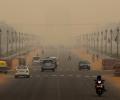
According to Central Pollution Control Board's (CPCB) Sameer app, the city's air quality index (AQI) stood at 449 in the severe category at 8 am on Saturday. It was 462 on Friday.

Under the emergency plan, stringent actions are implemented based on the air quality of the city.
Sunil Bharala, the chairman of the state Labour Welfare Council, said stubble burning is an 'age-old practice'.

After a long and harsh spell of heatwave, Delhi witnessed a pleasant morning on Thursday, with the weather department saying parts of the national capital received light rains.

Delhi recorded its coldest January morning in three years with the minimum temperature dropping to 3 degrees Celsius. Cold wave conditions are expected to persist, and air quality has deteriorated to the 'very poor' category.
The sustainable impact of this process is under scrutiny, Tripathi added.


'Many of these patients arrive at emergency departments in distress, struggling to breathe and requiring immediate medical intervention.'

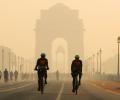
Dense fog enveloped Delhi for a second consecutive morning, leading to disruptions in air and rail traffic. Visibility dropped to zero in several areas, causing delays for 81 trains and diversions for 15 flights. The Met office attributed the fog to calm surface winds, and predicted continued dense to very dense fog throughout the day. Meanwhile, the national capital's air quality remained in the 'very poor' category, with an AQI reading of 380 at 9 am.
Violation of the provisions entails a punishment of a jail term up to five years or with fine up to Rs 1 crore or with both, the ordinance released by the Ministry of Law and Justice on Thursday said.

Air quality index (AQI) soared past 350 level in parts of Delhi on Thursday and experts cautioned that as weather turns colder it may breach the 400-mark ceiling and enter the 'severe' zone soon, notwithstanding the incidents of stubble burnings which have nosedived from 17,529 in 2020 to 4,262 this year.

The Congress on Friday claimed that a 'silent undercurrent' is brewing across western Uttar Pradesh against the 'failures' of the Modi government, as it flagged issues such as 'neglect' of sugarcane farmers and examination paper leaks.

The city recorded a minimum temperature of 14.6 degrees Celsius, a notch above normal, according to the India Meteorological Department.
The work to remove 377 metric tonnes of hazardous waste from the now-defunct Union Carbide factory in Bhopal has begun. The waste will be transported to an incineration site in Pithampur near Indore, around 250 km from Bhopal. The move comes after the Madhya Pradesh High Court ordered the authorities to clear the site, 40 years after the deadly gas leak that killed thousands and left hundreds of thousands with health problems.

The maximum temperature on Saturday settled at 18.1 degrees Celsius, two notches below the season's average, and the minimum was recorded at 3.6 degrees Celsius, four notches below the season's average, the IMD said.

Ramesh asked the PM why river Ganga is "dirtier than before" even after spending Rs 20,000 crore on the Namami Gange project.

The rains could lead to a rise in the water levels of the Yamuna, which has been flowing above the danger mark of 205.33 metres for days now.

The green panel said that innocent people drank and bathed in the river with reverence, without knowing that it may adversely affect their health.

Delhi's air quality deteriorated significantly on Monday, with areas like Dwarka, Mundka and Najafgarh recording an AQI of 500, the worst this season. The city's overall AQI reached 491, triggering the implementation of the Graded Response Action Plan (GRAP) Stage-IV restrictions in Delhi-NCR. Doctors warned of health risks, urging people to wear N95 masks and avoid outdoor activities. The Supreme Court questioned the Delhi government on its anti-pollution measures and warned against scaling down preventive measures without its permission. Delhi Chief Minister Atishi accused the BJP-led central government of political maneuvering while neglecting stubble burning in states it governs. Meanwhile, the city enforced stricter pollution control measures, including a ban on truck entry and suspension of construction activities. Air purifier sales surged, reflecting the public's concern over the severe air pollution.

The Centre on Monday earmarked a separate Rs 2,217 crore for 42 urban centres to tackle air pollution and announced the much-awaited voluntary vehicle scrapping policy to phase out old and polluting vehicles, even as it shrunk the budgetary allocation for the environment ministry from the last fiscal by nearly eight percent. Union Finance Minister Nirmala Sitharaman, in her budget speech for 2021-22, announced a total of Rs 2869.93 crore for the ministry, Rs 230 crore less than the last fiscal. Officials said the outlay has been lesser this time as the economy is recovering from the COVID-19 pandemic.
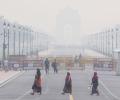
The capital witnessed a clear morning on Friday with the minimum temperature settling a notch below normal at 14.6 degrees Celsius.
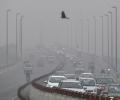
With Delhi recording air pollution levels seven to eight times above safe standards on Monday, the city government announced the return of its flagship odd-even scheme after four years anticipating further deterioration of air quality post-Diwali.
According to a survey carried out by the Central Pollution Control Board (CPCB), the accepted set value for crackers is 124 decibels at a distance of four m from the point of detonation, but 95 per cent of crackers breach this noise and pollution standard.

Residents of south Delhi's Okhla area were delighted to see what they thought was the season's first snowfall. But they were enraged after realising that it was toxic ash from a large waste-to-energy plant operated by Jindal Ecopolis in the neighbourhood.
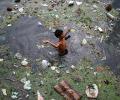
If industrial units do not have functional PETPs, then they will not be allowed to function any more, the court said.

The petition alleged that "illegal mining" was being carried out by Singh, the MP from Kaiserganj, in Majharath, Jaitpur and Nawabganj villages of Tarbganj tehsil in the district.

India captain Rohit Sharma assured BCCI boss Sourav Ganguly that his team is ready to play Sunday's opening T20 International against Bangladesh despite growing concerns about severe air pollution.
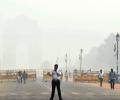
The overall AQI deteriorated further and touched the 268 mark, which falls in the poor category.

Delhi's air quality plummeted to alarming levels on Tuesday after 24 days, with many areas witnessing a significant spike in pollution despite the strictest measures, including a ban on construction activities and the entry of trucks into the city, coming into force.

Delhi will become the first such city in India to have such a scheme and the only one after Beijing in Asia.
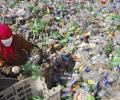
The issue of pollution caused due to the non-degradable material is keeping consumer goods majors - from ITC and Dabur to Nestl and PepsiCo - on their toes.

The Uttar Pradesh government, citing a scientist, has asserted that Ganga water at the ongoing Maha Kumbh in Prayagraj is as pure as "alkaline water", debunking concerns raised by the Central Pollution Control Board (CPCB) about water quality. The government claims that a scientist found no bacterial growth or decline in the water's pH level, despite millions of devotees bathing in the river. However, experts caution that the quality of the Ganga water is not static and can vary greatly depending on various factors.

The Indian government has stated that the water in the Ganga river at Triveni Sangam in Prayagraj was fit for bathing during the recently concluded Maha Kumbh, citing a new report from the Central Pollution Control Board (CPCB). The report, however, contradicts an earlier CPCB report that found high faecal coliform levels at several locations in Prayagraj during the Maha Kumbh. The government also highlighted measures taken to ensure water quality during the event, including the installation of sewage treatment plants and the use of advanced oxidation techniques to treat wastewater.

The city's air quality index stood at 385 at 9.05 am, while that of Noida, Gurgaon and Greater Noida was recorded at 406, 363, 296, respectively.
A team of the Central Pollution Control Board, which visited the fabled Silk Route in 2007, a year after it was reopened for cross border trade between China and India, found that expansion of the trade route was disturbing the ecosystem of the area. "Reopened with an aim to boost trade between China and India, ongoing expansion of one of the world's highest navigable roads is in progress without any precaution of the possible environmental impact," the Board said.

With such announcements grabbing the voters' attention, critical issues like pollution, especially the smog that chokes Delhi every winter, remain largely unaddressed. Many residents have raised concerns over the lack of concrete action plans to combat air pollution, which continues to pose a severe health risk to Delhiites.

The city's Air Quality Index (AQI) stood at 420 at 8 am on Thursday, compared to 426 at 4 pm on Wednesday. The AQI map prepared by the Central Pollution Control Board showed clusters of red dots (indicating hazardous air quality) spread across the Indo-Gangetic plains.
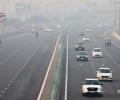
The city's 24-hour Air Quality Index (AQI), recorded at 4 pm daily, stood at 417, making it the worst in the country. On Friday, the AQI level was 396.

The Centre directed Uttar Pradesh and Bihar on Sunday to prevent dumping of dead bodies in the Ganga and its tributaries, and focus on their safe disposal and a dignified cremation after corpses were seen floating in these rivers following a spurt in the number of coronavirus cases.

The eight areas that recorded 'severe' air quality Saturday are Anand Vihar, Dwarka Sector 8, Narela, Punjabi Bagh, Bawana, Mundaka, Vivek Vihar and Rohini.
